Lawrencium Explained: Properties, Discovery, and Uses\n\n## Introduction to Lawrencium: The Elusive Element\nHey there, guys! Ever wondered about those really
weird
elements at the very bottom of the periodic table, the ones that are so rare and hard to create that they almost feel like something out of a sci-fi movie? Well, today we’re diving deep into one such intriguing element:
Lawrencium (Lr)
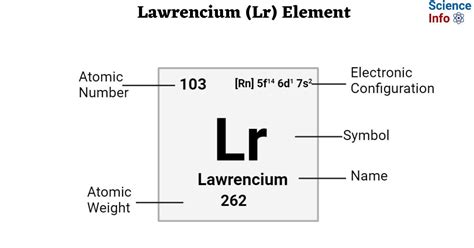
. This isn’t your everyday oxygen or iron; Lawrencium is a synthetic, highly radioactive element, and it’s truly a marvel of modern nuclear physics. It holds a special place as the eleventh transuranic element and the final member of the actinide series, sitting proudly at atomic number 103. Imagining its existence alone is fascinating, considering it doesn’t occur naturally on Earth. Instead, scientists have to
make
it in highly specialized laboratories, using particle accelerators to smash atoms together at incredible speeds. The whole process is mind-boggling, requiring precision and an understanding of nuclear reactions that are way beyond what most of us learn in high school chemistry. Its extreme radioactivity means it decays almost as quickly as it’s formed, making it incredibly challenging to study. We’re talking about half-lives measured in mere minutes or even seconds for its most stable isotopes, which adds another layer of complexity to understanding its properties. Despite these immense difficulties, scientists have managed to glean some insights into its characteristics, allowing us to piece together its story and confirm its rightful place in the periodic table. Understanding elements like
Lawrencium
isn’t just about adding another name to a list; it’s about pushing the boundaries of our knowledge, exploring the fundamental forces that govern matter, and uncovering the secrets of the universe at its most basic level. So, grab your lab coats (or just a comfy chair!), because we’re about to explore the captivating world of Lawrencium, from its dramatic discovery to its mind-bending properties and why it continues to be a subject of intense scientific curiosity. It’s a journey into the heart of matter, guys, and it’s pretty awesome!\n\n## Unveiling Lawrencium’s History: A Glimpse into its Discovery\nAlright, guys, let’s turn back the clock and talk about how this
super-cool
element,
Lawrencium
, first came into existence, at least in a human-made sense. The story of Lawrencium’s discovery is truly a testament to scientific perseverance and international collaboration, a real highlight in the history of nuclear chemistry. It all began in the early 1960s, specifically in 1961, at the famous Lawrence Berkeley National Laboratory in California, USA. A team of brilliant scientists, led by Albert Ghiorso, along with Torbjørn Sikkeland, Almon Larsh, and Robert M. Latimer, were the first to officially synthesize and identify this new element. They named it
Lawrencium
in honor of Ernest O. Lawrence, the inventor of the cyclotron, which was the very type of particle accelerator crucial for making such heavy elements possible. Imagine the scene, guys: they weren’t just mixing chemicals in a beaker; they were using a massive linear accelerator to bombard a target made of californium (an element itself discovered at Berkeley!) with boron ions. This wasn’t a simple “mix-and-match” situation; it was a high-energy collision designed to fuse atomic nuclei together, creating something entirely new. The specific reaction involved bombarding californium-249 (²⁴⁹Cf) with boron-10 (¹⁰B) and boron-11 (¹¹B) ions. This intricate process led to the creation of the isotope Lawrencium-258 (²⁵⁸Lr) and possibly others. The initial evidence for its creation was based on the detection of alpha particles emitted during the decay of the newly formed atoms, a tell-tale sign of heavy element synthesis. While the Berkeley team was the first to report its discovery, the scientific community, as it often does with these superheavy elements, sought further confirmation. Later, in the 1960s and 1970s, researchers at the Joint Institute for Nuclear Research (JINR) in Dubna, Russia, also contributed significantly to the understanding of Lawrencium and its isotopes, confirming much of the earlier work and synthesizing new isotopes. There was a bit of a friendly rivalry and discussion over naming rights and credit for these heavy elements, which eventually led to international agreements overseen by IUPAC (International Union of Pure and Applied Chemistry). Ultimately, the name
Lawrencium
stuck, a fitting tribute to the pioneering spirit of Berkeley Lab and its contributions to science. This collaborative yet competitive spirit pushed the boundaries of what we thought was possible, proving that with enough ingenuity and powerful technology, we can literally create new elements that don’t exist naturally! Pretty wild, right?\n\n## Understanding Lawrencium’s Properties: What Makes It Unique?\nSo, now that we know how
Lawrencium
came to be, let’s get into the nitty-gritty of
what it actually is
and
what makes it tick
. Understanding Lawrencium’s properties is like trying to describe a ghost – it’s incredibly elusive, constantly changing, and only observable through its faint traces. Remember, guys, we’re talking about an element with an atomic number of 103, symbolized as Lr. This places it firmly in the actinide series, though it often acts more like a transactinide element in some respects, bridging the gap between the actinides and the superheavy elements that follow. Being at the end of the actinide series, it’s theorized to have an electronic configuration that makes it behave like a typical group 3 element, similar to scandium, yttrium, and its lighter actinide cousin, lutetium. The most stable known isotope,
Lawrencium-262 (²⁶²Lr)
, boasts a half-life of about 3.6 hours, which, compared to many other superheavy elements that decay in milliseconds, is practically an
eternity
in this realm! This relatively longer half-life is what makes it somewhat more amenable to chemical study, allowing scientists a tiny window to probe its fundamental characteristics. Most of Lawrencium’s predicted properties are based on theoretical calculations and extrapolations from lighter, more stable elements, because, let’s be real, you can’t just pick up a chunk of Lr and put it on a scale! Scientists predict it would be a solid metal at room temperature, likely silvery-white or metallic in appearance, much like other metals. Its density and melting point are also theoretical, estimated to be quite high, consistent with other heavy metals. Chemically, the big question has always been about its most stable oxidation state. While +3 is generally expected for actinides, early predictions and some experiments suggested that +1 could also be a significant oxidation state, due to relativistic effects on its electrons. However, more recent and refined experiments, primarily studying its behavior in solution, have strongly confirmed that the +3 oxidation state is overwhelmingly the most stable and dominant. This finding is crucial because it helps to solidify its position as the last actinide and provides valuable data for understanding the chemical trends of these superheavy elements.
Lawrencium’s uniqueness
really comes from this blend of theoretical prediction and the extreme experimental challenges required to confirm those theories, making every piece of verified data a triumph.\n\n### Physical and Chemical Characteristics\nAs a synthetic element,
Lawrencium (Lr)
doesn’t have macroscopic physical properties that have been directly observed in bulk form. However, based on its position in the periodic table and relativistic calculations, it is predicted to be a
silvery-white or metallic-looking solid
at room temperature, similar to other heavy metals. Its high atomic number (103) suggests a very dense material. The chemical behavior of Lawrencium is primarily dominated by its predicted stable +3 oxidation state, meaning it would likely form compounds where it loses three electrons. This is a common characteristic among the actinides. Initial studies and theoretical predictions debated the possibility of a +1 oxidation state due to relativistic effects, where electrons move so fast their mass increases, altering their orbitals. However, more recent and rigorous experimental studies, often involving chromatography and solvent extraction techniques with
only a few atoms
of Lr, have confirmed that the
+3 oxidation state is by far the most stable and common
. This behavior aligns it well with other trivalent lanthanides and actinides, making it a valuable benchmark for understanding the chemistry of the heaviest elements. These studies also indicate that Lawrencium is a
highly reactive metal
, readily forming ionic compounds.\n\n### Isotopes and Their Stability\nWhen we talk about
Lawrencium
, we’re not just talking about one type of atom. Like most elements, it exists in several isotopic forms, meaning atoms with the same number of protons (103) but different numbers of neutrons. Currently,
eleven isotopes of Lawrencium
have been characterized, ranging in mass number from Lr-252 to Lr-266, along with one known metastable state (Lr-253m). The stability of these isotopes varies dramatically, with half-lives ranging from mere milliseconds to several hours. For example, Lr-252 has a half-life of only 0.36 seconds, decaying via alpha emission. On the other hand, the most stable and scientifically significant isotope is
Lawrencium-262 (²⁶²Lr)
, which boasts a relatively impressive half-life of
approximately 3.6 hours
. This particular isotope is formed through the alpha decay of Dubnium-266 (²⁶⁶Db). The varying half-lives of these
Lawrencium isotopes
provide crucial data for nuclear physicists studying nuclear structure, decay pathways, and the effects of increasing atomic number on nuclear stability. The trend generally shows that as the number of neutrons increases, the isotopes tend to become slightly more stable within this incredibly unstable region of the periodic table, although all Lawrencium isotopes are still profoundly radioactive and decay fairly quickly.\n\n## The Rarity and Challenges of Studying Lawrencium\nLet’s be real, guys, studying something like
Lawrencium
isn’t like doing a simple titration in high school chemistry. It’s
extremely
challenging, and that’s largely due to its incredible rarity and instability. Imagine trying to study something that you can only make a few atoms of at a time, and then it vanishes almost as quickly as it appears! This is the daily reality for scientists working with Lr. First off, Lawrencium doesn’t occur naturally on Earth. It’s a purely synthetic element, which means every single atom of it has to be painstakingly
created
in a laboratory. This creation process involves immensely powerful particle accelerators, like cyclotrons, that smash lighter atomic nuclei together with incredible force. The target materials themselves, often other rare and radioactive elements like californium, are incredibly expensive and difficult to produce. Then, the actual synthesis yields are minuscule, typically only a few atoms per experiment, if you’re lucky! We’re talking about an unbelievably small quantity of material, far less than what you could ever see or hold. Once these precious atoms are created, the clock starts ticking. As we discussed, even the most stable isotope, Lawrencium-262, has a half-life of only about 3.6 hours. Many other isotopes decay in seconds or even milliseconds. This means scientists have to perform experiments
extremely quickly
and efficiently. They don’t have the luxury of letting samples sit around; every measurement needs to be done almost instantly after synthesis. This “atom-at-a-time” chemistry requires highly specialized, sensitive detection techniques and rapid separation methods. Think automated chemical systems designed to isolate and analyze these fleeting atoms before they decay completely. The equipment is cutting-edge, incredibly complex, and requires a dedicated team of experts to operate. Furthermore, the radioactivity involved in handling these elements, even in tiny amounts, necessitates stringent safety protocols and heavily shielded facilities. The data obtained from these experiments is often indirect, relying on the detection of decay products or specific interaction patterns rather than direct observation of bulk material. These challenges make every piece of information we gather about
Lawrencium
a monumental achievement, pushing the boundaries of experimental design and technological innovation. It’s a testament to human ingenuity and the relentless pursuit of knowledge, even when faced with seemingly insurmountable obstacles.\n\n## Where Does Lawrencium Fit? Its Place in the Periodic Table\nOkay, guys, let’s talk about where
Lawrencium (Lr)
calls home on our beloved periodic table. This isn’t just about its atomic number (103); it’s about understanding the deep, fundamental reasons why elements behave the way they do based on their electron configurations and nuclear structures. Lawrencium holds a
very significant position
as the last element in the actinide series, which is usually depicted as a separate row below the main body of the periodic table, along with the lanthanides. These elements, starting from actinium (Ac) and ending with Lawrencium (Lr), are characterized by the filling of their 5f electron shells. This filling of inner f-orbitals gives them their unique chemical properties, often leading to a dominant +3 oxidation state. However, Lawrencium is also a bit of a
boundary-crosser
. While it’s officially the last actinide, its predicted and experimentally verified chemical behavior, particularly its strong preference for the +3 oxidation state and its electronic configuration, also makes it an excellent candidate for the first transactinide element in Group 3, directly below lutetium (Lu). This dual classification highlights the fascinating transition zone it occupies in the periodic table. The debate about whether Lawrencium is strictly an actinide or should be considered the first of the transactinides (Group 3, period 7 element) has been a long-standing one among chemists and physicists. The IUPAC (International Union of Pure and Applied Chemistry) currently places it as the final actinide, but its position directly beneath lutetium in the extended periodic table, alongside scandium and yttrium in Group 3, is also strongly supported by its chemical properties. Understanding Lawrencium’s exact placement and its
chemical behavior
is crucial for accurately predicting the properties of even heavier, yet-to-be-discovered elements. It helps scientists build theoretical models that account for relativistic effects, which become increasingly important for elements with very high atomic numbers. These relativistic effects cause electrons to move at speeds significant fractions of the speed of light, altering their mass and orbital shapes, which in turn influences chemical bonding and properties. So, Lawrencium isn’t just an element; it’s a
key marker
in our ongoing quest to fully map out and comprehend the universe’s building blocks, guiding us into the realm of superheavy elements and the very limits of matter stability. It shows us that even our most fundamental charts, like the periodic table, have layers of complexity waiting to be fully understood!\n\n## Beyond the Lab: Potential Applications and Future Research\nAlright, guys, let’s be upfront: if you’re looking for everyday uses for
Lawrencium
, like putting it in your smartphone or using it for medical imaging, you’re going to be disappointed. Due to its extreme rarity, high radioactivity, and incredibly short half-life, Lawrencium has
no practical applications
outside of fundamental scientific research. You won’t find it in any commercial products, and it’s not going to be powering your future gadgets. However, saying it has no “applications” doesn’t mean it’s useless – quite the opposite! The true value of Lawrencium lies squarely in its role as a
gateway to deeper understanding
of nuclear physics and chemistry. Each atom of
Lawrencium
created and studied provides invaluable data that helps scientists refine their theories about nuclear structure, the strong nuclear force, and the behavior of electrons in extremely heavy atoms. Researchers use Lawrencium to test theoretical models that predict the properties of superheavy elements, those elements with atomic numbers greater than 103, which are even more challenging to synthesize and study. By understanding how Lawrencium behaves, scientists can better predict what elements 104, 105, and beyond might be like, and where the elusive “island of stability” might lie. The “island of stability” is a theoretical concept in nuclear physics that proposes that certain superheavy isotopes, with specific “magic numbers” of protons and neutrons, could have significantly longer half-lives than their neighbors, potentially lasting for minutes, days, or even millions of years! Lawrencium, being right at the edge of the known heaviest elements, helps us navigate towards this theoretical island. Future research will continue to focus on synthesizing new, heavier isotopes of Lawrencium to precisely determine their half-lives and decay modes. This will further test our understanding of nuclear stability and help to map the landscape of superheavy nuclei. Additionally, detailed studies of its chemical behavior, even with just a few atoms, contribute to a more complete picture of relativistic effects on electron shells, which are profound in these heavy elements and can drastically alter expected chemical properties. So, while it’s not a material for building things,
Lawrencium
is an
essential tool
for constructing our knowledge about the fundamental limits of matter, showing us what’s possible at the extreme edges of the periodic table. It’s truly a frontier element, guys, pushing the boundaries of scientific exploration!\n\n## Conclusion: The Enduring Mystery of Lawrencium\nAnd there you have it, guys – our deep dive into the fascinating, albeit fleeting, world of
Lawrencium
. From its dramatic debut at Berkeley Lab in 1961 to its pivotal role in contemporary nuclear research, Lr-103 stands as a monumental achievement in human ingenuity and scientific exploration. This purely synthetic element, named in honor of cyclotron pioneer Ernest O. Lawrence, is a testament to the fact that we can, with enough dedication and advanced technology, literally
create new building blocks of the universe
. We’ve seen how its position as the final actinide, with an atomic number of 103, makes it a critical bridge element, connecting the familiar world of lighter elements to the enigmatic realm of superheavy elements. Its most stable isotope,
Lawrencium-262
, with its relatively “long” half-life of 3.6 hours, offers a precious, albeit brief, window into its predicted +3 oxidation state and other chemical behaviors. Despite the immense challenges posed by its extreme rarity and rapid decay – requiring scientists to conduct “atom-at-a-time” chemistry – every piece of data gathered on Lawrencium is a treasure. These insights aren’t just for curiosity’s sake; they’re vital for refining our understanding of nuclear forces, the effects of relativity on electron structure, and ultimately, for guiding the search for the theoretical “island of stability” where even heavier elements might enjoy longer, more measurable lifetimes. Lawrencium might not have practical applications in our daily lives, but its existence and study are invaluable to the scientific community. It pushes the boundaries of our knowledge, challenging physicists and chemists to innovate, to develop new experimental techniques, and to expand our theoretical frameworks. So, the next time you glance at a periodic table, remember Lawrencium – that elusive, man-made element that, despite its ephemeral nature, continues to unlock profound secrets about the fundamental nature of matter. It reminds us that there’s always more to discover, always more to understand, even at the very edges of our known universe. Keep exploring, guys!
